Close Lane and Dunnocksfold Road
Close Lane
Most building on this road is recent, though some is inter-war. For example, in May 1934 S.E. Wells of Haslington, a builder, advertised ‘non-parlour and parlour type houses with garage, elec; mortgage arranged’. Most of the west side, and a small part of the east, is within Haslington parish. Two buildings on the east side survive from the 19th century: Crowle Cottage, in Haslington, and Madeley Cottage (no 53). This was bought in 1876 by George Gater; it was occupied at the time on a 90-year lease, suggesting it had been relatively recently built.
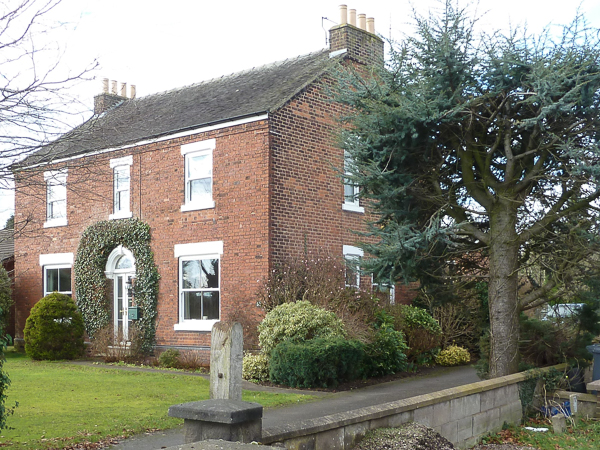
Dunnocksfold Road (leading to Dunnocksfold farm, also in Haslington parish) crosses what was known as the Heath, or Common, south of Manor Farm. Though normally farmed by a tenant, a 19th century owner of Manor Farm was Thomas Twemlow, who built a new farmhouse which bear his initials and the date, 1885.
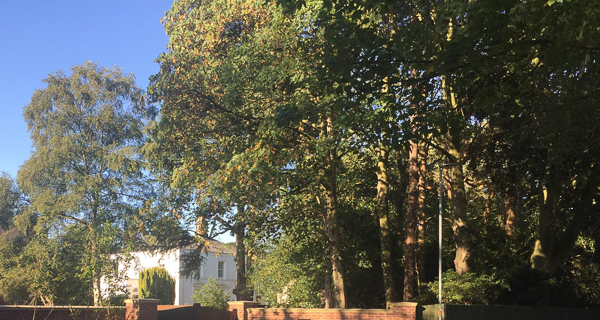
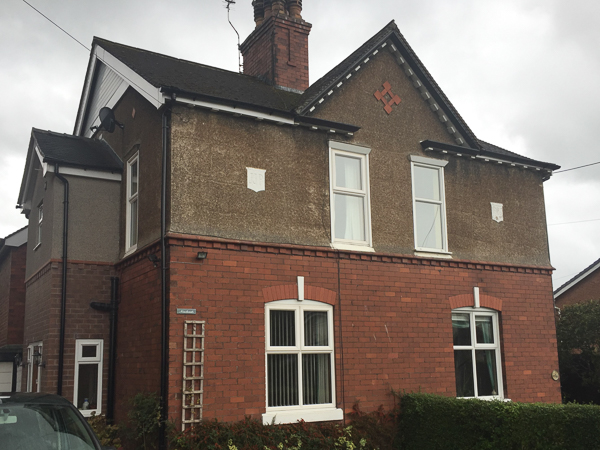
Heathfields dates from about 1858, and is mentioned in 1860 as one of two villas recently built in Alsager. (This ignored at least Grove House in Hassall Road, nearby, to name but one.) It was built – on the site of a plantation of trees – by Henry Ford, a young solicitor, brought up in Congleton by his mother and stepfather, attorney John Egerton Ward. He lived here with his wife Eliza, two sons and two daughters, until his death in 1878; it remained Eliza’s home until 1905, after which it passed into the hands of the Palfreymans, pawnbrokers in Hanley. J. J. Palfreyman built the cottages, nos. 44 and 46, in 1906, in parallel with alterations to his own residence.
Ward, Henry Ford’s stepfather, was a friend of William Mellor, a substantial farmer at Smallwood, who also ran cheese-factoring businesses in Sheffield and Cheshire, the latter with his son in law, William Key. Key married Mellor’s daughter Ann, sister of Eliza Ford. Their brother, Robert Mellor, lived for a while in the Sunnyside area with Key (possibly at Sunnyside Cottage itself), before acquiring the farms surrounding Alsager estate lands on the south side of the Crewe Road, building the house he called The Hill.
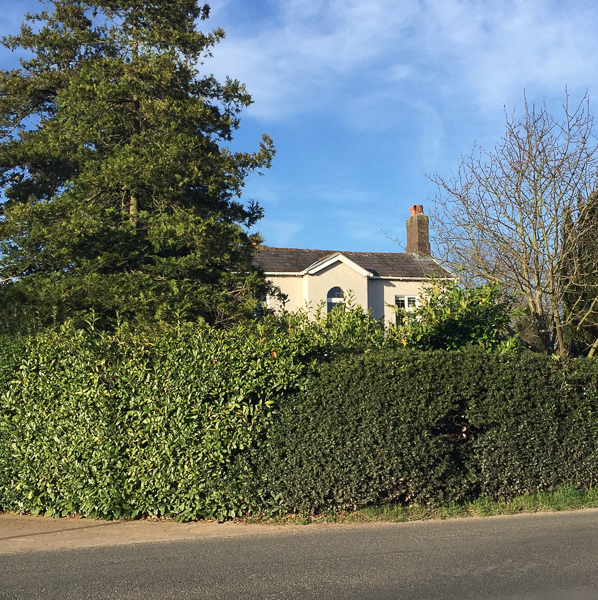
Sunnyside as a name derives from the house once known as Sunnyside Cottage, now no. 37. In 1862, this was the location chosen by fraudsters for delivery of wrongfully-acquired household goods. Their system was described in the contemporary press as a ‘long firm fraud’, the perpetrators themselves – Henry James and James Percy Edwards – being described as part of ‘the (so-called) long firm’. Their method was to order large and expensive goods – furniture, dog-carts, hay-making machines – on credit from unwary urban dealers as far apart as Chester, Bristol, Leicester and Manchester, based on oral ‘references’ from non-existent referees. The stuff was then delivered, only to be re-sold and moved on swiftly, the original supplier remaining unpaid. Alsager was chosen for delivery because of its central situation on the railway, and the fraudsters rented the ‘small house’ (which parts of the press suggested they even named) for a year. Its relative seclusion must have been a factor in this. They were given 18 months’ hard labour on a charge relating to one transaction in Manchester.
The name Sunnyside was eventually adopted for the road formed slightly to the east; for a farm a little further west; and for the general area. It isn’t obvious who the developer or developers of the street now called Sunnyside were. In 1870 Henry Ford himself advertised ‘eligible plots of land in quantities of half an acre or thereabouts, near the Church… for villa residences’. George Plant, one of the buyers of land round the Mere who became its trustees, was at Sunnyside Cottage in the early 1870s; the new houses were advertised from 1877. One of the houses in this area, which its occupier called Albion Villa, was the home of E.F. Leek, one of the other Mere trustees, who built Coniston Lodge in the Avenue.
Most of the rest of the houses on Dunnocksfold Road have been built during the 20th century, beginning in 1933 at the eastern end, when Joseph Edwards replaced plans for bungalows with others for detached houses.