Crewe Road west – south side from the Lodge Inn to Hall Farm
Before Crewe became a major railway interchange this was known as the Barthomley Road. The road wasn’t much built up before the 1860s, and the existing buildings are entirely a post-railway phenomenon.
Half a mile of road frontage was advertised for sale in 1852, making the most of the view towards Christ Church and the ‘few minutes’ walk’ to the station. The builder-developer concerned at the time was Rawlinson, probably the farmer of that name. There were few takers. But John Fox, farmer and victualler at the old Lodge, ceased farming and transferred the public house part of his business to a new building on the main road, where he held a grand opening dinner at the new Lodge Inn in the summer of 1854. The advent of the railway meant that this was a much better site for an inn than the old Lodge, and public meetings which might previously have taken place at the Lodge went to the Alsager Arms instead.
From 1853 to 1881, long leases were granted along this stretch. About 1855, at least four ‘cottage houses’ with gardens were built. The builder was Samuel Harding. It is not known exactly which (or how large) they actually were, but it’s quite likely that they are west of the Inn but near it. Others, which also fit the profile of the plot, may be from the 1860s, when four carcases were sold unfinished. As far as Farfield, the land on the south side of Crewe Road, west of Station Road, had been part of the estate comprising Hole House (later Home) Farm. Behind the farm, the large house known first as the Hill was built about 1863. Its instigator, Robert Mellor (1816-94), was born in Smallwood (where his father, a farmer, had a substantial cheese business), but had retired from ‘trade’ by 1861. His sister Eliza was married to Henry Ford, of Heathfields.
The Hill (later renamed the Hall) was rebuilt after a fire in 1953. Around 1912 it was noted as having 5 principal and 4 other bedrooms and garaging for 5 cars. The latter must have originated during the tenure of Joel Settle (1858-1926), a mining engineer from Lancashire and owner of the railway works at Linley, who was its tenant after it was given up by Mellor’s heirs and who bought it outright in 1903.
Mellor continued development of the road frontage on very long leases, starting by 1864 if not earlier. By the 1870s most of the south side of the road, between the Lodge Inn and Farfield, was lined with houses, and most of the houses here date from this period. The 4 semi-detached houses at 176 to 182 Crewe Road comprise Oak villas (the name Oak Villa is still borne by no. 182) and their cement-fronted neighbours at 176 and 178 as Portland villas (one was also known as Portland View). They were all probably built around 1867.
The White House, no. 132, though broadly contemporary, stands out from the others not only because of its rendering and its colour, but because of unusual windows. Its first known inhabitants were the family of Henry Burgess, a cooper’s son who became a cabinet-maker in Waterloo Road and then owned the Kilncroft pottery works in Chapel Lane, Burslem, making ware mainly for the North American market. After the death of one of their daughters (there were at least seven, and later several sons), in 1878 or the following year Henry and Ann Burgess built and moved to the Woodlands, which formerly stood further west on the other side of Crewe Road. Notable among their successors at the White House were W. E. Baines, brought up in Fields Road and the husband of the Burgesses’ daughter Ann; and Richard Thistlethwaite, who moved here from Church Road in the 1900s. He ran here a private school for boys aged 7 and upwards, leaving around the end of the decade to teach at a larger school at Strawberry Hill, Twickenham.
No. 148 has been in its time known as Woodbine Cottage, one of at least three houses in the town bearing the name Woodbine at some time or other. An early resident was Mary Ann Wood; it may not be too fanciful to suggest that she gave it this name. The family firm of Edwards had moved here from elsewhere in Crewe Road by 1895; Joseph Edwards, brother of George, was one of the town’s most prominent builders, having started as a joiner, and his name lives on in the present undertakers’ business.
Where Poppyfields now joins the main road is the site of Maple Hayes, first recorded in 1871 as in the possession of Frederick Salt, solicitor; he was resident in Burslem in the spring of that year, when the census was taken, and later had offices at Piccadilly Chambers in Tunstall as well as at Crewe and Sandbach. In the late 1870s the house had a large flower and kitchen garden, summerhouse, tool-house, greenhouse, coach-house loft and stabling for 2 horses, as well as a saddle-house and washhouse (there is no mention of a bathroom). Apparently as an afterthought, the auction particulars also mention 5 bedrooms, front and back staircase, three receptions, a good kitchen, cellar, and pantries.
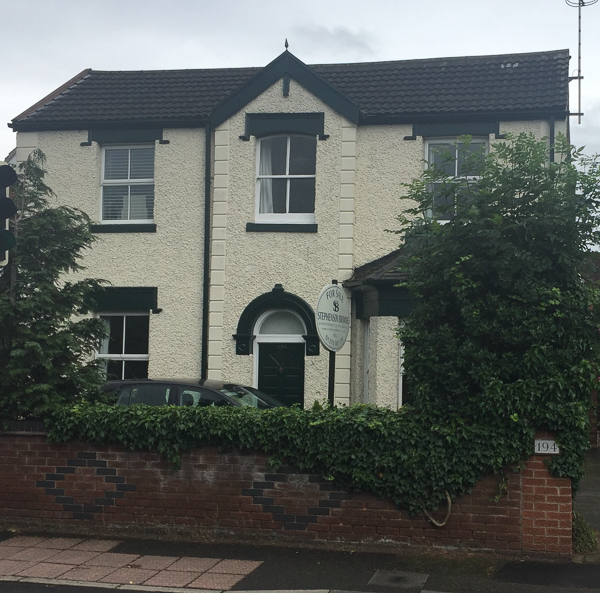
To the east of the site of Maple Hayes, no. 194, formerly Birch House – one of a modern group of houses in its former grounds now bears this name – was described at the start of the 20th century as ‘a detached square built small house’. The building, which like Maple Hayes and Farfield was built on Mellor land, probably dates like them to around 1870; early occupiers during the 1880s were the family of George Alcock, self-styled as a former builder, who started as a joiner in Burslem and dealt then and afterwards in furniture. Later it was the home of the council’s surveyor, Harry Lynam, to whom much of the early 20th century streetscape of the town is owed.
Farfield was sold in 1870, then part of a total of 5 acres, for £900; this gives a likely date of building for the house, which was given (and retains) the name of the original field. Described around 1912 as an ‘older residence in Gothic style’, it cost £1300 to build. It comprised 7 bedrooms, 3 reception rooms and stabling, together with croquet lawn, garden and meadow. There was a separate servants’ staircase. An early owner, possibly the earliest, who came here after the death of her husband, was Isabella Spencer, with her two young daughters. She was the widow of a clergyman, Almerie Spencer, who had been the first incumbent of Christ Church, Burbage, Derbyshire, near his family’s residence, for some three years before his very early death in 1864. His father had been bishop of Madras and later chancellor of St Paul’s Cathedral. Isabella is likely to have left Alsager about 1876. Around this time the house was tenanted for a short time by Henry Poole. Henry Poole senior had been a mining engineer in Nova Scotia, where his three daughters were born; he had a son, also Henry, so it is not certain which of the two Henrys was tenant of Farfield. Later residents during the 1880s included Moses Johnson, a civil engineer who died here in 1893. He had had a glittering career, advising inter alia the King of Burma. Subsequent tenants included Edward Williams, a brick and tile manufacturer, and from 1898 Arthur Ellis (1849-1941), the Burslem solicitor with whom Arnold Bennett’s father trained, and who is said to have been the model for Mr Duncalf in The Card.
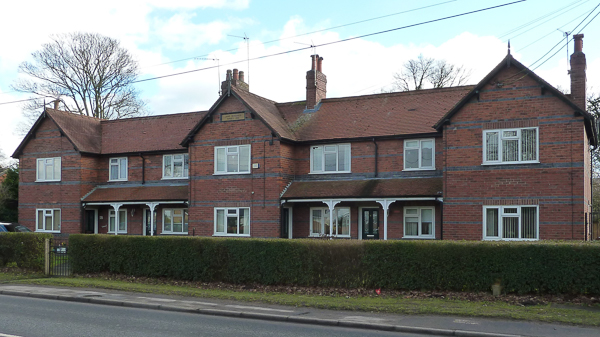
The Jane Maddock Homes were provided in 1901 by the youngest daughter of James Maddock (of Brundrett House), as almshouses for five single women . They are unusual not only in being a modern foundation but also tall and well-proportioned as a building. Jane Maddock (1849-1929) lived for at least the latter half of her life at Torquay, though she made other local benefactions, notably educational bursaries for girls in Burslem and at the School of Art there.
A mill, one of several associated with farms, has existed nearby since time immemorial, and appears to have been documented since the 13th century. It was still in operation in the 1930s, as were mills at Rode Heath and Betchton; at this one the miller also dealt in cattle and poultry food. The nearby Hall Farm, identified as the centre of the settlement of the family who took their name from the township, is still the centre of one of Alsager’s larger farmed estates, having run to between 150 and 200 acres throughout the 19th century. The farmhouse was described as ‘recently rebuilt’ in 1876 and as ‘modern’ in 1889.